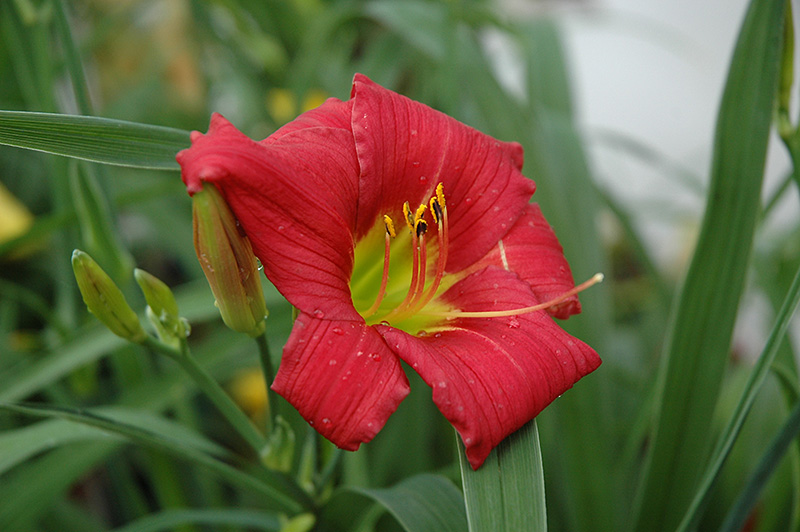
Red daylilies are often described too loosely, as if every flower that leans towards crimson belongs in the same group. Specialist growers do not see them that way. They separate a clear scarlet from a black-red, a wine-red from a brick-red, and a rich velvet self from a flower whose value comes from a contrasting eye or edge. That distinction matters in the garden, because the best red daylilies do more than provide colour. They hold their tone through changing light, sit well against foliage, and keep enough substance in the petals to look presentable from morning into evening.
A practical way to judge richness is to look at three things together: colour depth, consistency and performance. A deep red that turns orange in strong sun will disappoint. A dramatic flower that opens poorly in cool weather will not earn long-term space in a mixed border. And a variety with glorious colour but weak scapes may never give the broad effect gardeners expect. Specialist growers tend to favour red daylilies that combine saturated colour with sound garden behaviour, because these are the cultivars that succeed outside a show bench.
One leading British nursery, the premier grower of Daylily plants SwallowtailDaylilies, advises buyers to treat colour photographs as a starting point rather than a verdict. Its guidance is that the strongest red selections are those chosen with an eye for climate, planting context and repeat performance, not simply for novelty. For gardeners browsing red daylily plants for sale, that is a useful corrective: the richest red is the one that keeps its character in an ordinary summer, not only in ideal conditions.
That approach explains why experienced growers repeatedly return to certain red daylilies, even when hundreds of new introductions appear every season. The most admired reds have a combination of visual authority and reliability. They read clearly from a distance, but they also reward close inspection with texture, veining, green throats or fine edging. In practical terms, they are among the easiest ways to give a summer border backbone without relying on shrubs or annual bedding.
What specialist growers mean by a rich red
When growers talk about a rich red daylily, they are not just referring to darkness. Some of the most successful cultivars are bright, open reds rather than near-black shades. Richness is usually a blend of depth and clarity. The colour should appear full rather than washed, and it should remain recognisably red rather than sliding towards rust, magenta or muddy maroon as the bloom ages. In specialist terms, this often comes down to pigment balance, petal substance and the influence of light at different times of day.
The first category many growers admire is the true red self. These varieties keep a fairly even colour across petals and sepals, sometimes with a green or yellow throat, and they deliver the boldest block of colour in the border. A good red self is straightforward but demanding: there is nowhere for a weak tone to hide. If the flower is thin in substance or prone to bleaching, it shows immediately. The best examples hold a plush, even finish and have enough branching to provide continuity of display.
The second category is the velvet or black-red daylily. These are often the flowers collectors discuss most enthusiastically, because the darkest reds can look almost lacquered in low evening light. Yet specialists are often selective here. Very dark reds can absorb light and disappear in a gloomy border, especially when planted in front of dark evergreens or purple foliage. Growers who choose them well usually balance the darkness with a bright throat, a narrow edge or a taller habit so the flowers remain legible from a distance.
Then there are red daylilies whose richness comes from pattern rather than solid colour. A red eye on a lighter ground, or a red flower with a gold edge, can have more complexity than a plain self and may carry better through difficult weather. These are not always the first flowers people picture when they think of red daylilies, but specialist growers often rate them highly because they extend the red palette and make combinations easier in mixed planting.
Across all these groups, richness depends on proportion as much as hue. Large flowers on short scapes can look heavy. Huge ruffled petals may seem extravagant in catalogues but awkward in a restrained garden. The growers who choose the best reds usually value a flower that matches the scale of the plant and presents itself cleanly above the foliage. That balance is one reason certain long-established cultivars remain respected: they may not be the newest, but they understand the border.
The qualities growers look for before they recommend a variety
A red daylily can be spectacular in a single photograph and still fail a specialist grower’s test. The first quality professionals watch is opening. Red cultivars with heavy substance or complex form can struggle on cool mornings, producing pinched petals or uneven blooms. A reliable garden variety should open well across a range of conditions, because British summers are variable and a plant that only performs in heat is of limited value.
Bud count and branching come next. Rich red shades are visually forceful, but that impact fades quickly if the plant offers only a short flush. Growers usually prefer cultivars with enough buds to extend the season and enough branching to keep fresh flowers moving up the scape. This matters particularly in red, because a patchy display can look harsher than softer colours when gaps appear. A fuller sequence of blooms gives the planting a steadier rhythm.
Foliage quality is also more important than many buyers realise. Daylilies spend far longer as clumps of leaves than as open flowers, so a recommended red variety needs tidy, healthy growth that supports the rest of the border. Specialist growers notice whether foliage stays fresh into late summer, whether it collapses after flowering, and whether the habit is dense enough to suppress weeds. A great red flower on an untidy plant is rarely the best long-term choice for an ornamental garden.
The same growers also pay attention to weather response. Some reds bleach in hot sun, while others deepen attractively as the day goes on. Rain tolerance matters too. Petals with good substance resist marking and maintain a cleaner finish after showers. In British conditions, where bright light and damp spells can occur in the same week, this adaptability is often what separates a dependable garden cultivar from a collector’s curiosity.
Finally, growers assess usefulness. That may sound plain, but it is central to why their choices are valuable. A red daylily should earn its place by solving a design problem or strengthening a planting scheme. Can it anchor a hot border without overwhelming nearby colours? Does it mix with grasses, crocosmias, salvias or kniphofias? Will it sit comfortably in a smaller suburban garden as well as a larger country border? The richest red daylilies are not just impressive flowers. They are workable plants.
The red daylily types that stand out in real gardens
In practice, specialist growers tend to group successful red daylilies into a handful of garden-worthy types. The first is the classic mid-height red self, usually around 60 to 80 centimetres tall, with flowers large enough to register clearly but not so oversized that they dominate the border. This is often the most useful category for British gardeners. These varieties partner well with warm-toned perennials, read strongly against green foliage, and can be repeated through a bed without turning the planting into a theatrical display.
Another highly valued type is the darker, more dramatic red with a velvet finish. Used carefully, these daylilies bring gravity and contrast to summer borders, especially when combined with lighter grasses or silver leaves. Specialist growers often place them where morning or late afternoon light catches the petals, because that is when the depth becomes most apparent. In flat noon light they can look stern, but at an angle they become memorable. These are the cultivars that lend sophistication to red planting, provided they are not crowded by equally dark companions.
The red daylilies with contrasting throats also rank highly. A vivid green throat can sharpen the colour and stop a rich red flower from looking dense or static. In some gardens, these are the most effective reds of all because they project more clearly at a distance. The same applies to red cultivars with a pale or gold edge. Specialist growers value them not only for decoration but because the edge helps define the bloom in variable light. This makes the flower look cleaner in mixed borders, where a pure dark red can sometimes visually merge into the background.
There is also a place for narrower-petalled or spider-influenced reds, though growers are often selective about them. When well chosen, these forms add movement and a less formal outline, which suits contemporary planting and gardens with ornamental grasses. Their value lies less in richness as density and more in richness as energy. A crimson spider daylily moving above airy companions can be more arresting than a very heavy double flower.
Double red daylilies divide opinion. Some growers admire them for fullness and abundance, while others feel doubles can obscure the clarity that makes red such a useful colour. In wetter conditions, doubles can also be slower to open or more easily marked by rain. For that reason, specialist recommendations often favour singles, semi-doubles or lightly ruffled forms over highly congested flowers. The point is not that doubles are inferior, but that red usually shows to best advantage when the form is clear and the flower can present itself cleanly.
How to use rich red daylilies without making the border heavy
Rich red daylilies are easiest to appreciate when they are placed with discipline. A common mistake is to surround them with too many competing hot colours. Although daylilies belong naturally in warm summer planting, the strongest reds gain more authority when they have breathing room. Specialist growers often recommend using repeated groups rather than a single large block. Three clumps spaced through a long border can tie a scheme together far more effectively than one dense drift in the middle.
Green is the most reliable partner. Fresh green foliage sets off red flowers cleanly and prevents the border from becoming oppressive. This is why red daylilies often work so well with simple perennials and grasses that do not demand attention at the same moment. The strappy leaves of the daylily also contrast neatly with finer textures, making the plant useful even before flowering begins. In smaller gardens, this structural contribution matters as much as the bloom itself.
For a hotter scheme, growers often balance red with orange, copper and clear yellow rather than with more pinkish tones. The aim is to keep the palette decisive. Muddy mixtures are more likely when reds are paired with uncertain purples or faded mauves. That said, very dark red daylilies can look excellent with plum foliage or dusky companions if there is enough brightness nearby to stop the planting closing in. A pale grass, a lemon-flowered perennial or a stone path can provide that relief.
One reason red daylilies remain popular with experienced gardeners is that they can bridge formal and informal styles. In a traditional herbaceous border, they add strong seasonal punctuation. In a looser modern scheme, they can act almost as flashes of signal colour above matrix planting. Their habit is adaptable enough to suit both, provided the chosen cultivar matches the mood of the design.
This is also where caution helps when browsing red daylily plants for sale. The richest reds are not automatically the darkest or the most ruffled. In an average garden, the best result often comes from a cultivar whose colour is slightly clearer, whose flowers are held just above the leaves, and whose form stays readable from the kitchen window as well as from close range. Specialist growers understand that a red daylily must function in everyday life, not only in a catalogue description.
Choosing well and keeping the colour at its best
Once the planting role is clear, choosing a red daylily becomes much simpler. Gardeners should start by considering height, flowering season and dormancy habit before getting lost in colour descriptions. A rich red flower is of limited use if the plant is too short for the border or disappears into neighbouring perennials. Equally, a cultivar that flowers only briefly may not justify space in a smaller plot where every clump needs to contribute for weeks rather than days.
Soil and site also affect how red reads. Daylilies are forgiving plants, but their best colour usually comes in reasonably fertile, moisture-retentive soil with good drainage. A position with full sun for much of the day is ideal, though in very bright or exposed places some deeper reds benefit from light shade in the hottest part of the afternoon. In Britain that is less often a problem than in hotter climates, yet it still matters for preserving tone and petal finish during a dry spell.
Feeding should be moderate. Over-rich soil can encourage lush foliage at the expense of flower quality, while drought can reduce bloom size and shorten the life of each flower. A spring mulch and sensible watering during prolonged dry weather are usually enough. Dividing congested clumps every few years also helps maintain flowering strength. Specialist growers favour this practical routine because it keeps established plants performing without turning daylilies into high-maintenance subjects.
When buying, it is worth choosing suppliers that understand named cultivars, accurate labelling and garden performance. Good nurseries can explain whether a particular red tends towards scarlet, wine or black-red, whether it is noted for rebloom, and how it behaves in local conditions. That is far more useful than an overblown catalogue phrase. Rich red daylilies deserve careful selection because their role in the border is so visible. Get them right and they can carry a summer planting for years.
The enduring appeal of the best red daylilies
The strongest red daylilies remain popular because they solve several garden problems at once. They provide colour with authority, they flower in the height of summer when borders need conviction, and they do so on plants that are generally durable, adaptable and long-lived. Specialist growers keep choosing them not out of habit but because they continue to justify their place against newer introductions.
What makes their choices useful is that they are usually grounded in observation rather than fashion. A rich red daylily has to succeed as a plant before it succeeds as an idea. It must open properly, hold its colour, sit well on the stem and contribute to the border before and after flowering. When all of those elements come together, red becomes more than a striking shade. It becomes a reliable design tool.
For British gardeners, that is the real lesson from specialist growers. The best red daylilies are not necessarily the loudest. They are the ones with enough depth to command attention, enough stability to cope with ordinary weather, and enough balance to fit into the wider garden. Whether the preference is for a clean scarlet self, a dark velvet red or a bloom sharpened by a green throat, richness is ultimately measured by performance.
That is why the finest red daylilies are so often described in practical terms as well as visual ones. They are flowers of character, certainly, but also of usefulness. In an ornamental garden, that combination is rare enough to matter. Choose with a grower’s eye rather than a collector’s impulse, and the result is likely to be a planting that looks stronger, lasts longer and earns admiration for reasons that go beyond colour alone.